
The One-Page Map That Makes Strategy Executable
by Cesario Ramos
A Strategy Alignment Map in CAO (adapted from Kaplan, R. S., & Norton, D. P. (2000). Having trouble with your strategy? Then map it. Harvard Business Review) is the one-page bridge between strategy and organizational design. It translates ambition into action. It shows what the organization must be able to do exceptionally well to deliver its chosen outcomes.
Too often, strategy lives in slide decks while structure, processes, and KPIs live somewhere else. The capability map connects them. It turns intent into a cause-and-effect story the whole organization can understand and act upon
The Strategy Alignment Map
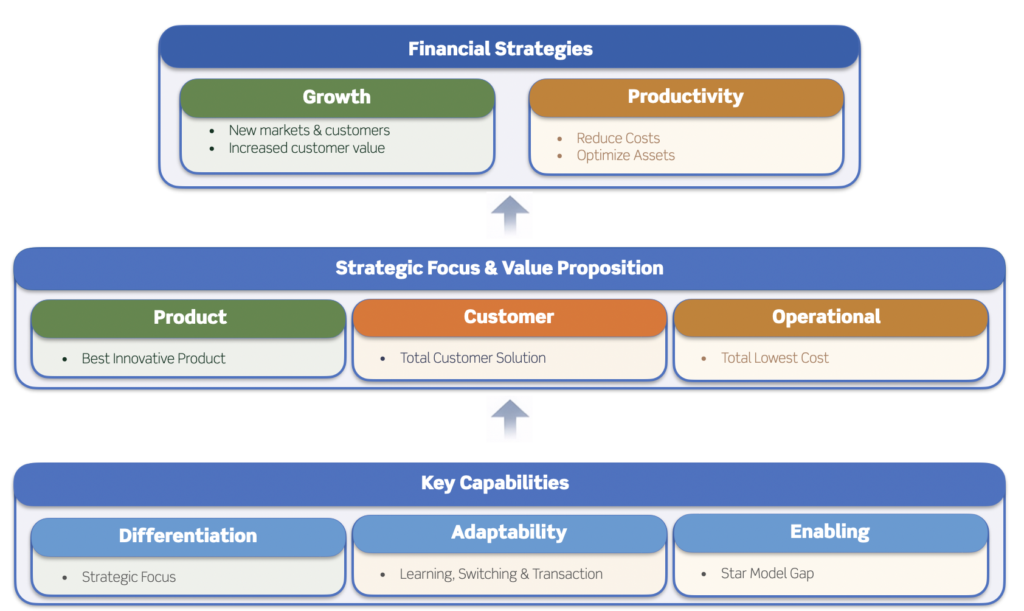
Fig 1. The CAO Strategy Alignment Map from the book “Changing The Engine Midflight”
The map is read Top-Down: From Financial strategies to Capabilities
Financial Strategies
The map starts with the organizational objective. At the top typically sit two primary levers:
- Revenue Growth: new markets, new products, new customers, and deeper relationships with existing ones.
- Productivity: lower cost structures and better asset utilization.
From there, you clarify the strategic intent: are you prioritizing Growth, Productivity, or a deliberate balance of both?
Strategic Focus and Value Proposition
The center of the map defines the Strategic Focus and Value Proposition: how you will win. Most organizations anchor themselves in one dominant differentiator:
- Operational excellence ( Total Lowest Cost)
- Customer intimacy (Total Customer Solution)
- Product leadership (Premium Innovative Products)
You can’t be best at everything. But you must meet threshold performance in the others.
Once the value proposition is clear, the next question becomes practical: What must we be able to do to deliver this consistently?
Capabilities: Differentiation, Adaptability, and Enabling
A strong capability map makes three things explicit:
1. Differentiation Capabilities
Where must we be truly best? What creates competitive advantage?
2. Adaptability Capabilities
How quickly must we learn, adjust, and execute? Speed of adaptation is often as important as the initial strategy.
3. Enabling Capabilities
What is our operating system? Decision rights, governance, data, technology, talent, leadership, and coordination mechanisms.
This is where strategy becomes real.
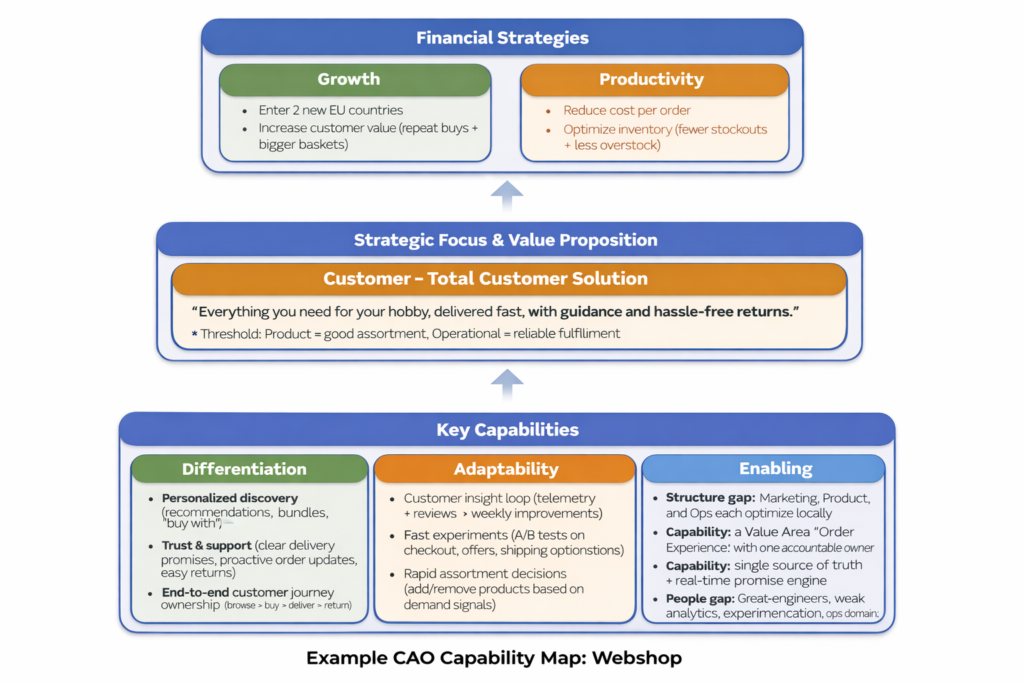
Simplified Example in Practice
From KPI Dashboards to a Shared Execution Story
Many organizations manage through KPI dashboards. But KPIs without a capability logic are just measurements. A capability map changes that.
It forces clarity on:
- What we will invest in
- What we will measure
- What must improve to deliver the value proposition
- And just as importantly, what we will stop doing
The payoff is communication. A single causal story that links financial outcomes to daily work. A shared understanding of why certain capabilities matter more than others.
Build the map top-down.
Start with outcomes. Define how you will win. Then design the capabilities to make it real. That is how strategy becomes executable.
Now make it actionable.
Create one enterprise capability map. Make it the single reference. Share it widely. Then ask every business leader and product-group leader to build their own map. It must connect to the enterprise map. Review them side by side.
This is where the value appears:
- Gaps: the enterprise outcome depends on a capability nobody owns, funds, or builds.
- Overlaps: multiple groups build the same capability in parallel, with different standards.
- Broken cause-and-effect links: local initiatives do not plausibly drive the stated outcome, or key steps in the chain are missing.
Fix those issues. Align investments. Align priorities. Align accountability.
The CAO Infinity Loop
Next, develop the required capabilities using the CAO Design Guides and the Infinity Loop.
As shown in Figure 3, the approach starts at the top. Strategy sits at the center, shaped by two forces you cannot ignore: market conditions and internal challenges. Together, they define the direction the organization must follow to win.
From that strategy, define the capabilities you need: what the organization must be able to do reliably to deliver the outcomes. Capabilities are not generic. Some are tied to your strategic focus (product, customer, operational). Others are about adaptability—your ability to sense, learn, shift, and execute as conditions change.
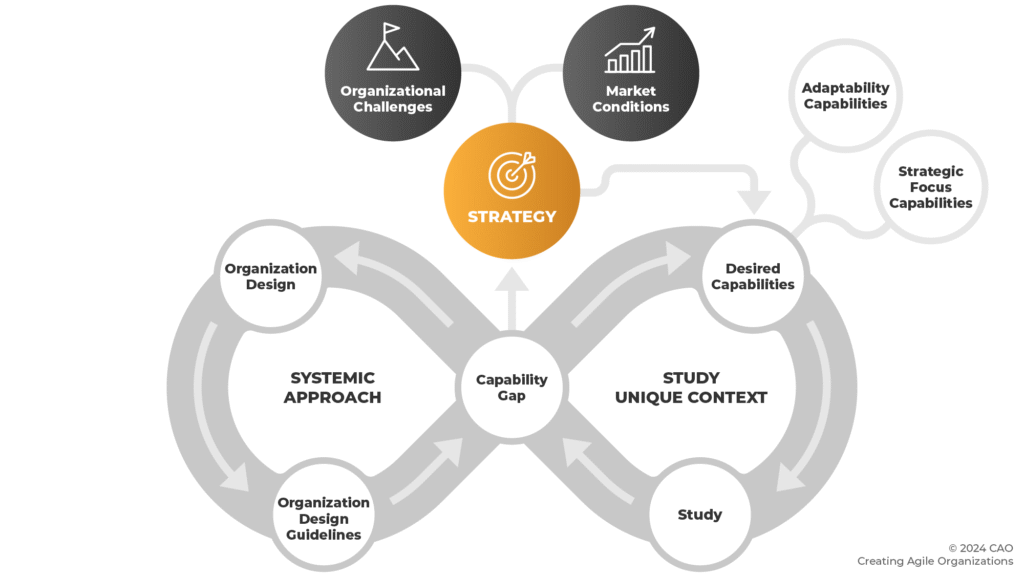
Figure 3. Overview of the CAO approach.
At the center sits the capability gap: the difference between what you need and what you can do today. That gap is the engine of design.
References
Oliveira Ramos C.A,, et al. (2026). Changing The Engine Mid-flight. (to be released)
Kaplan, R. S., & Norton, D. P. (2000). Having trouble with your strategy? Then map it. Harvard Business Review