
How AI Is Changing the Logic of Organization Design
by Cesario Ramos
I have spent 10s of years helping organizations improve for adaptability, flow, and end-to-end ownership. Mostly through Scrum, Emergent, LeSS, and Creating Agile Organizations(CAO). And I keep running into the same pattern: teams treated like Lego blocks without understanding the larger context of product, portfolio and strategy.
And what I often see when I join still comes down to this: we renamed the teams, redraw the boxes, added some interaction rules, and see if improvement happens. Then expect improvement will follow.
That logic only works if the problem is the boxes, and sometimes it is. But often the boxes are not the problem at all. It is how the work is divided, and I mean not just in tech, but across most organisation functions.
We Divide Work for Two Main Reasons
Organizations divide work for good reasons, mostly two.
- The first is complexity. Work becomes too broad, too deep, or too specialized for one person or one team to do effectively.
- The second is power. Putting too much authority in one place can be dangerous, so we create boundaries for governance, control, risk management, and oversight.
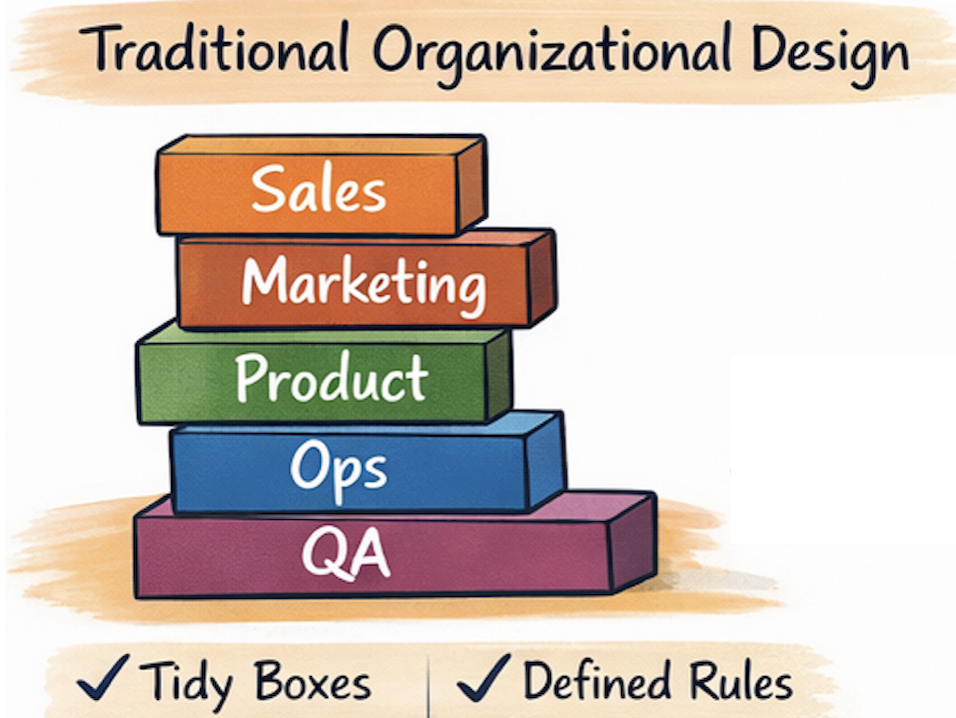
The first reason drove most of our specialization. And that specialization shaped the organization. This is not only about software, where one group does frontend, another backend, another testing, and yet another operations. The same pattern exists across the business.
For example: Marketing sits in one silo. Sales in another. Product in a third. Then operations, compliance, finance, service, and delivery each add their own boundaries, managers, queues, and priorities. And then we act surprised coordination costs rise and delivery becomes slow.
AI Changes the Economics of Division of Work
This is where AI becomes far more important than a simple productivity tool. AI changes how much work can be contained within a person, a team, or a unit. And when that changes, the economics of division of work change with it.
Business Process Example: Take a team trying to improve conversion in a B2B product. Traditionally, customer insight sits with sales. Messaging sits with marketing. Feature framing sits with product management. Data is owned somewhere else. So the work bounces across functions through meetings, handoffs, translation, delay, and rework.
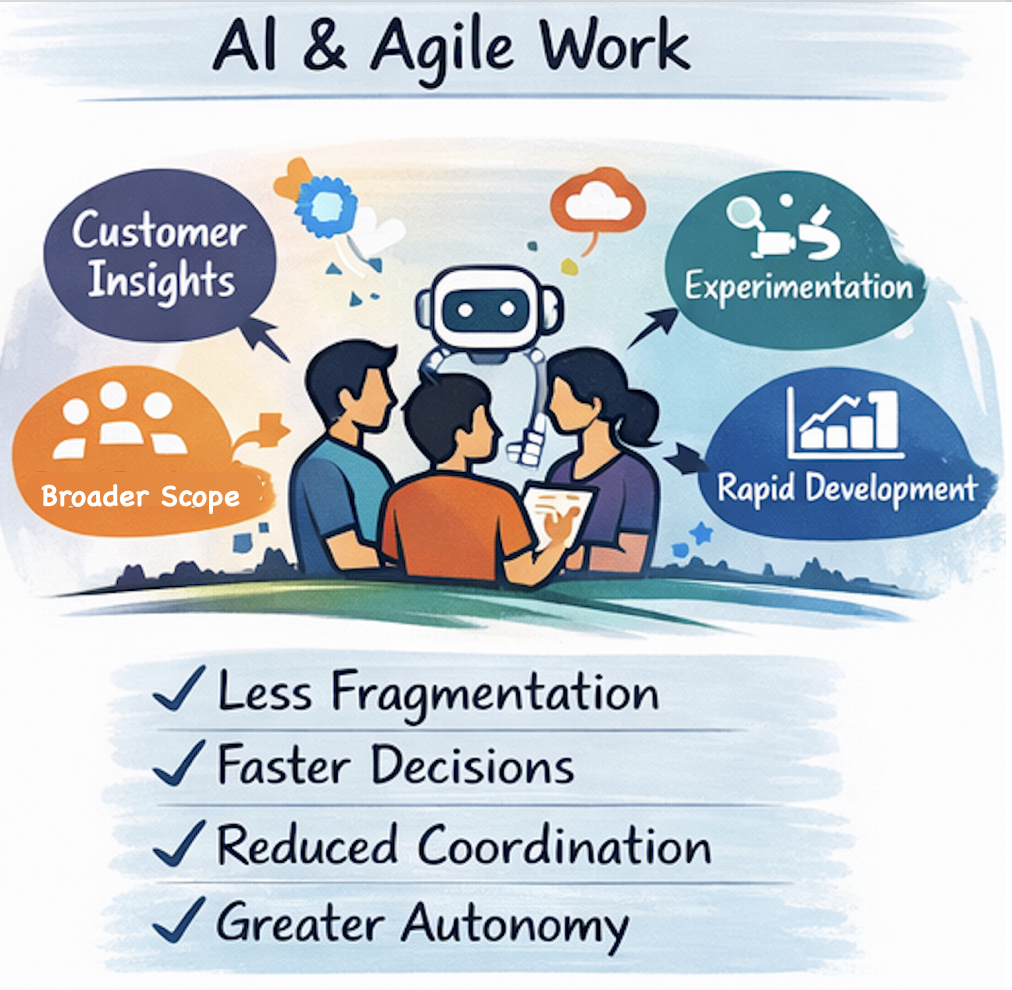
Now imagine a smaller team, supported by AI. That team can analyze call notes, synthesize customer objections, draft campaign angles, shape an experiment, and feed the learning back into product decisions much faster and with fewer functional boundaries. That is not magic. It does not eliminate expertise. But it does reduce fragmentation.
Programming Example: The same is true in product development. Twenty years ago, building a feature often meant moving work across a long chain of specialists. A UI change might pass from designer to frontend developer to backend developer to tester to operations. Every handoff introduced delay, clarification, misunderstanding, coordination cost, and rework.
And, to be honest, some organizations still work this way today…
Now a few capable developers, supported by AI, can often move much further across that chain. They can explore implementation options, write code across layers, generate tests, check edge cases, and prepare deployment steps. Not perfectly. Not always alone. But far more than before. Nothing special here, just a Scrum team as it could be.
Again, this is not just a productivity story. It is a shift in the economics of work design.
So what?
Well, this Matters for Organizational Design. When AI allows a person or team to contain more of the work, several important things change.
- Task interdependencies decrease.
- Coordination costs fall.
- More work can stay within the same role, team, or unit.
- And flow can improve.
In Creating Agile Organizations terms, this is significant. With the help of AI we can reduce accidental coupling, increase task independence and therefore coordination overhead drops, and value can move faster. As AI helps teams to contain more work we can actually build Scrum teams easier. (For 20+ years we have been trying to create these Scrum teams that work end-to-end, now its is becoming a no-brainer.)
That is what matters. Not frameworks that make coordination sound elegant while ignoring why so much coordination was needed in the first place. Because much of what passes for sophisticated organization design is really this: Designing around fragmented skill, then romanticising the coordination mess that follows.
Not Every Boundary Should Disappear
Of course, this does not mean all boundaries should dissapear. Some boundaries exist because the work is genuinely complex. Others exist because concentrated power is dangerous.
AI may reduce the first. It does not remove the second. Governance, control, audit, separation of duties, and risk management do not disappear simply because one person or team can now do more. That distinction matters. There are boundaries created by the limits of capability. And there are boundaries created by the need to constrain power. AI challenges many of the first kind. It does not automatically eliminate the second.
The Leadership Question
That leads to a question leaders should be asking: Which boundaries are still essential, and which ones exist only because yesterday’s work required more fragmentation than today’s work does?
That is the conversation I increasingly bring to clients. Not: how do we use AI to developer faster, not how to fit AI into our current model? But: how does AI change what the right model should be? That is why I do not see AI as only a productivity tool. I see it as an organizational design variable.
Key takeaways through the CAO lens
1. Treat AI as an organizational design variable, not just a productivity tool
In CAO, structure follows the work. If AI allows a person, team, or unit to contain more of the work, then the design assumptions behind roles, teams, and interfaces must be revisited.
2. Re-examine the real reason a boundary exists
CAO distinguishes between boundaries that are useful and boundaries that create waste. Ask: Is this boundary needed because the work is genuinely complex? Or is it only there because capability used to be fragmented? Or is it needed to constrain power, risk, or compliance?
That distinction matters.
3. Redesign for greater work containment
A core CAO idea is to increase the ability of teams and units to deliver value with less dependency on others. If AI helps a team do more end to end, redesign around that. Push more work inside the same team, not more coordination outside it.
4. Reduce accidental coupling
Many dependencies are not essential. They exist because skills, information, or decisions were split across functions. AI can reduce those splits. In CAO terms, that means a chance to eliminate accidental coupling and simplify the system.
5. Increase independence where AI makes it possible
CAO emphasizes semi-independent units and teams with clear responsibility for outcomes. If AI makes it easier for teams to handle broader work, then independence can increase and coordination overhead can decrease.
6. Stop romanticizing coordination
From a CAO perspective, coordination is necessary, but too often organizations design around coordination instead of reducing the need for it. The better question is not “How do we coordinate better?” but “Why is this coordination needed at all?”
7. Use AI to strengthen true end-to-end ownership
For years, many organizations wanted cross-functional, end-to-end teams but struggled to make them real. AI can help teams contain more skills and work. That makes CAO’s end-to-end design logic more achievable.
8. Keep governance boundaries where power concentration is risky
CAO is not about removing all boundaries. Some separations must remain because governance, audit, financial control, and risk management still matter. AI may reduce capability-based boundaries, but not all power-based boundaries.
9. Revisit product group and shared service design
AI may shift what should sit inside a product group versus what should remain shared. Some services that once needed centralization may now be embedded closer to the work. Others should stay centralized because they manage scale, policy, or control.
10. Start with strategy and value, not technology
In CAO, design begins with strategic intent and customer outcomes. So the question is not “Where can we deploy AI?” but “Where does AI change the economics of work enough that we should redesign for better flow, ownership, and adaptability?”